

A family kitchen concrete table example should answer more than a style question. It needs to show how a statement dining table earns its place between breakfast bowls, homework, weekend lunches and the occasional overenthusiastic craft project. In a busy open-plan home, the table is often the most-used piece of furniture in the room, so it must be beautiful enough to anchor the design and capable enough for real family life.
A hand-finished polished concrete table offers that balance. Its quiet, architectural surface can bring structure to a light-filled kitchen, soften the sharper lines of contemporary cabinetry, or give an extension the grounded focal point it needs. Each table carries subtle movement and tonal variation, making it feel made for the room rather than selected from a catalogue.
A family kitchen concrete table example in a real layout
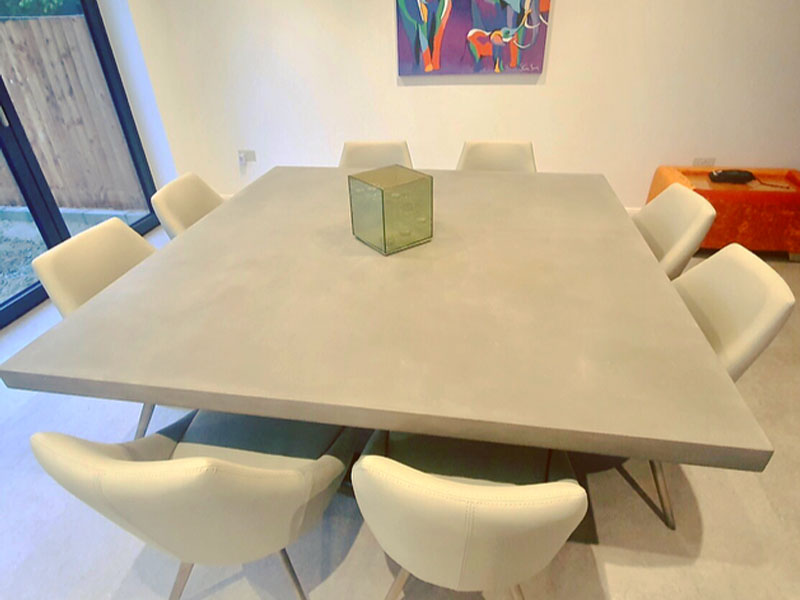
Picture a renovated kitchen with a long island, pale oak cabinetry and large doors opening onto the garden. The family need daily seating for five, room for grandparents on Sunday, and a table that does not disappear against the scale of the space. A 260 cm by 100 cm rectangular polished concrete dining table is a strong starting point.
At this size, the table comfortably seats eight for everyday meals, with the potential to host ten when required. A warm grey concrete top paired with a black powder-coated steel base gives the room an urban design edge, while upholstered dining chairs introduce comfort and texture. The result is a stunning centre piece, but not one that asks the household to treat it like a museum object.
The top should sit centrally within the dining zone rather than simply filling every available centimetre. Allowing a clear route around the table matters, particularly where children move between the garden, kitchen and dining area. As a practical guide, aim for around 90 cm behind occupied chairs, increasing this where a walkway is likely to be busy.
Start with how your family actually uses the room
The best table proportions come from daily habits, not just a floorplan. A family who eats at the table twice a day, works from home at one end and entertains regularly will need a different solution from one using the dining area mainly for weekend gatherings.
For a household of four to six, a six-seater table can feel generous without overwhelming the kitchen. An eight-seater is often the sweet spot for family homes with open-plan layouts: ample for everyday life, yet ready for friends and relatives without pulling out an extension leaf. Where the room has real width and entertaining is part of the brief, a 10 or 12-seater bespoke table creates a more sociable, generous setting.
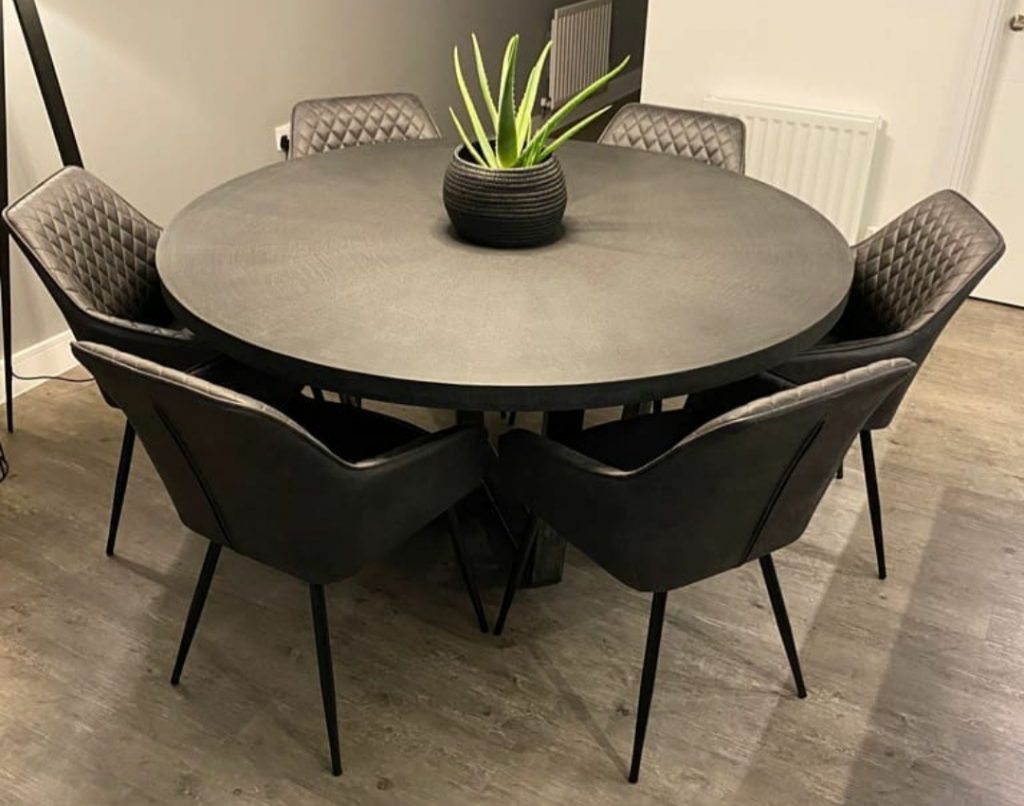
Shape changes the feel as much as size. Rectangular tables work especially well in long kitchen-diners and make efficient use of space. A softer oval can improve circulation in a room with active routes around it, while a round concrete table brings everyone into the conversation and suits a square dining area. The right answer depends on chair placement, door openings and how much visual weight the kitchen can carry.
Measure for chairs, not just the table top
It is easy to fall for a beautifully proportioned table on paper and forget the space needed once chairs are pulled back. As a rule, each diner needs roughly 60 cm of table edge to eat comfortably. Armchairs and generously upholstered seats require more room than slim dining chairs, so they should be considered from the beginning.
Base design is equally relevant. A central pedestal or inset leg arrangement may make it easier to add an extra place setting at the corners. More sculptural steel legs can make a powerful feature, but their position should be planned around where people naturally sit. Bespoke design is valuable here because a table can be built around the preferred chair count, rather than asking the family to work around a fixed format.
Why polished concrete suits everyday dining
Concrete has a reputation for toughness, and rightly so, but a dining table is not a paving slab. The appeal lies in the refinement of a carefully made, polished and protected surface. It retains the material’s natural character while becoming suitable for the way a kitchen is used every day.
A sealed polished concrete top is designed to be stain resistant and straightforward to maintain. Wipe up spills promptly, use a mild cleaner and avoid harsh abrasive products. Like timber, marble or any premium surface, it benefits from sensible care. Hot pans should still go on trivets, and chopping directly on the table is never a good idea, but there is no need to panic over a glass of squash, a plate of pasta or a well-used dining table.
The material also has a presence that becomes more convincing over time. Concrete is not printed to look like stone. Its pinholes, gentle clouding and hand-finished variation are part of its identity. For families who want their home to feel considered but lived in, that honest character is often more appealing than a perfectly uniform surface.
Choosing colour and finish for the kitchen
A family kitchen table should relate to the room without becoming overly matched. Grey remains a popular choice because it works with almost any palette, from dark graphite cabinetry and brushed metal to natural oak and soft limestone flooring. Yet grey is not one fixed colour. A pale, silvery finish can make a compact kitchen feel lighter, while a deeper charcoal tone gives a large extension more definition.
Warmer concrete shades sit particularly well with timber, brass, terracotta and earthy painted cabinetry. For a more dramatic scheme, a dark table can create a deliberate contrast beneath pendant lighting, especially when the kitchen itself is pale and minimal. Samples are useful because concrete responds to natural daylight differently across the day, and a finish that looks cool in a studio may appear warmer beside your flooring.
Legs offer another opportunity to tailor the piece. Black steel is a confident choice for contemporary homes, while lighter or more refined base designs can keep the table visually open. The aim is not to make every element compete. It is to create a table with enough character to hold the room together.
A standard size or a bespoke commission?
A Classic Collection table can be the sensible route when your room suits a proven six, eight or 10-seater configuration. Standardised dimensions bring stronger price efficiency and a more direct route from decision to delivery, without compromising the hand-finished quality of the table itself.
A bespoke commission comes into its own when the space has an unusual footprint, a bay window, a narrow dining zone or a very specific seating requirement. It is also the right choice when the details matter: an extended 12-seater top for big family gatherings, a softened corner profile for young children, a particular concrete colour, or legs designed to align with the architecture of the kitchen.
There is a useful trade-off to recognise. Bespoke does not automatically mean bigger or more elaborate. Sometimes the most successful made-to-measure table is simply 15 cm narrower than a standard size, leaving enough space for chairs and making the room work better every day.
Make the table feel welcoming, not precious
Concrete gives a kitchen-diner an architectural foundation, but the surrounding materials decide whether it feels relaxed. Timber chairs, woven textures, linen seat pads and a pendant with a warm pool of light all soften the material’s mineral quality. In a modern extension with hard surfaces and plenty of glazing, these elements are particularly effective.
Avoid covering the whole table permanently with runners or large decorative arrangements. One of the pleasures of polished concrete is seeing the surface and its subtle hand-finished detail. A simple bowl, a low vase or a few candles are enough when guests arrive, while the table can remain clear and useful for the rest of the week.
For a kitchen designed around real life, a concrete dining table should never be an afterthought. It should be planned as the point where the family gathers and the room settles into place. If you have dimensions, seating needs and a few images of the kitchen, speaking directly with Daniel about the build is the clearest way to turn that idea into a table made for your home.