
A dining table earns its place the hard way. It hosts hurried breakfasts, homework, red wine, birthday candles and the occasional ambitious Sunday lunch. When choosing the top durable dining table materials, the question is not simply which surface can survive a spill. It is which material will continue to look considered, feel right in the room and suit the way your household actually lives.
For a forever home, durability should mean more than resistance to marks. It should include structural strength, ease of care, repairability and an appearance that will not date after a few seasons. Here is how the leading choices compare.
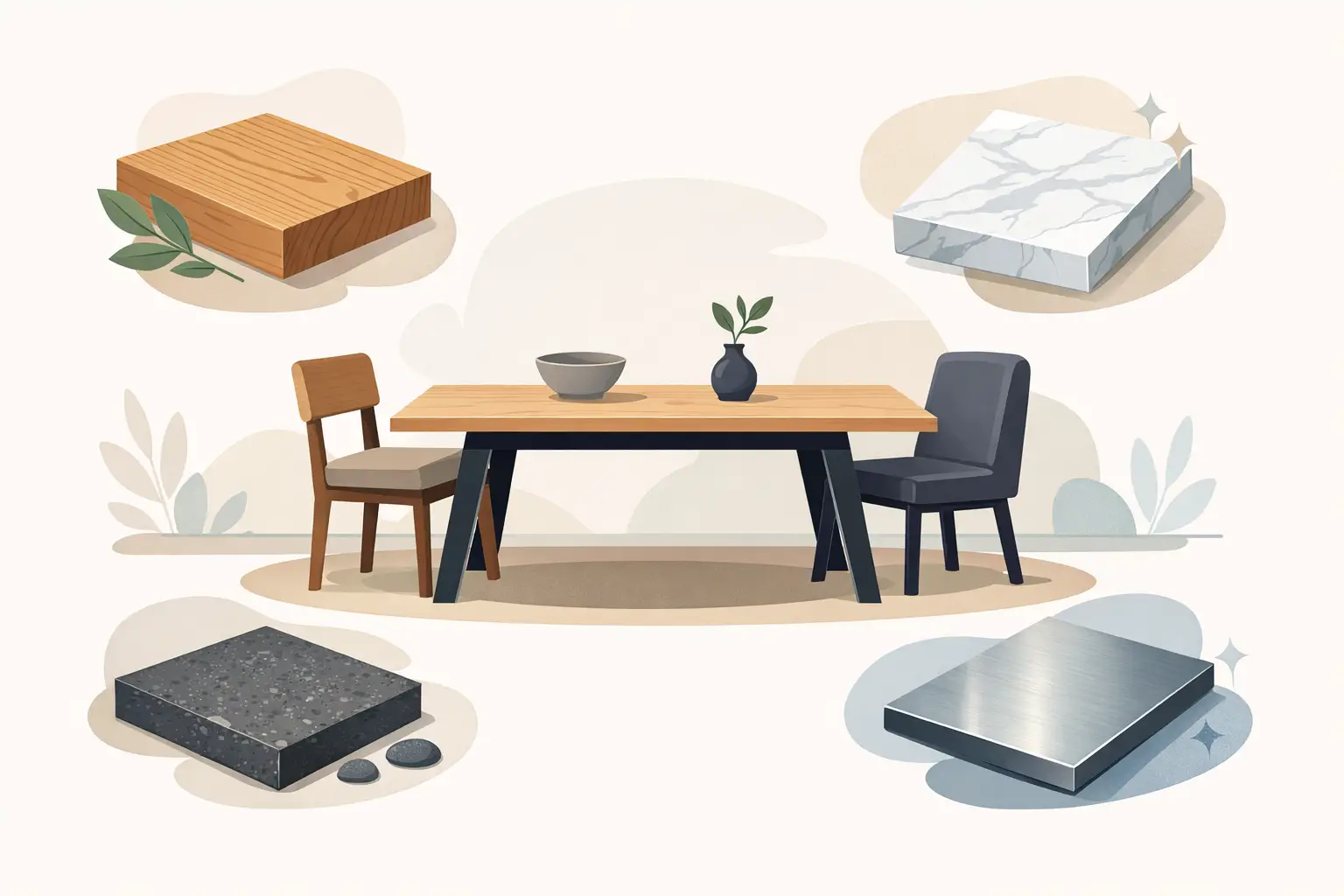
Top durable dining table materials, compared
Polished concrete: architectural, hard-wearing and individual
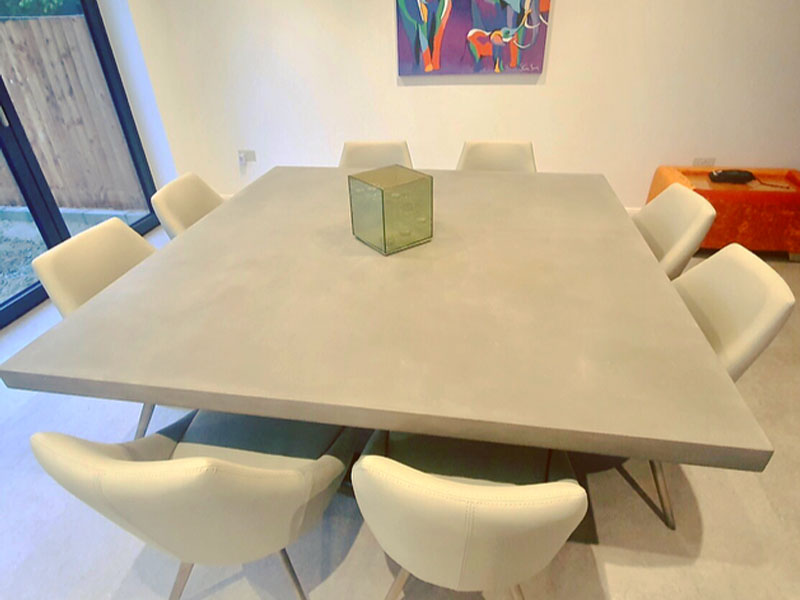
A polished concrete dining table brings a sense of permanence to a kitchen or open-plan dining space. Its mineral surface, substantial feel and hand-finished character make it a natural centre piece for contemporary homes, particularly where timber, steel, exposed brick or large-format stone already set the tone.
Concrete is exceptionally strong in everyday use. A professionally made table is reinforced, carefully cured and sealed to help resist staining and moisture. The result is a surface designed for family meals and regular entertaining, rather than something that needs protecting from normal life. It also holds its own at larger sizes, which matters when an eight, ten or twelve seater needs to feel elegant rather than overworked.
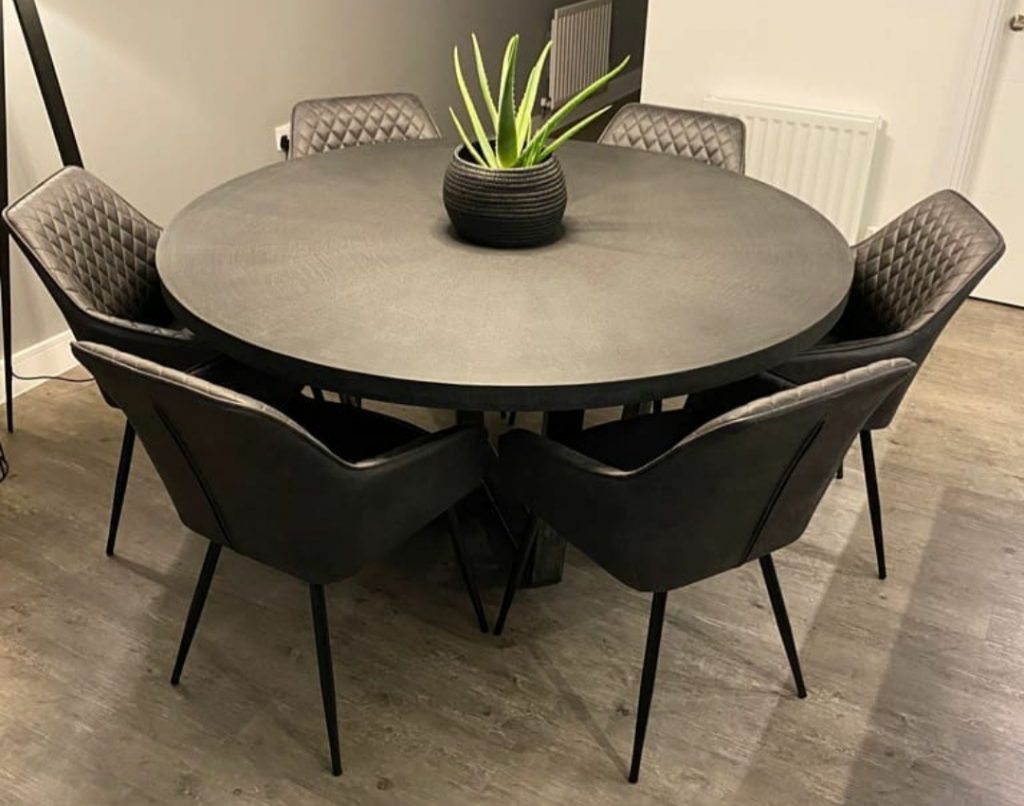
Its appeal is not just practical. Every polished concrete top has subtle movement in tone, small variations and a depth that cannot be reproduced by a printed finish. You can specify a shape, size, edge profile, colour and leg design to suit the room, whether that calls for a soft grey oval with oak legs or a darker rectangular top on architectural metal supports.
There are honest trade-offs. Concrete is weighty, so access, floor loading and delivery need proper consideration from the outset. It is also not a completely maintenance-free material. A quality seal should be respected: wipe up acidic spills promptly, use placemats for very hot cookware and avoid abrasive cleaners. Fine surface character may develop over time, but that is part of concrete’s lived-in appeal, not a failure of the material.
Solid hardwood: warm, repairable and timeless
Oak, walnut and ash remain popular for good reason. Solid hardwood has genuine visual warmth, works across traditional and modern interiors, and can last for generations when it is properly constructed. Unlike a thin veneer, a solid timber top can usually be sanded and refinished if years of use leave it scratched or tired.
Oak is the familiar all-rounder: tough, characterful and well suited to busy family spaces. Walnut offers richer colouring and a more luxurious look, although it is generally softer than oak. Ash can feel lighter and more contemporary, with a distinctive grain that pairs well with pale, design-led interiors.
Wood’s weakness is also its charm: it changes. Direct sunlight can alter the colour, and moisture, heat and fluctuating indoor humidity can cause movement. Water rings, dents and scratches are possible, especially on oiled finishes. Some owners love the patina this creates. Others want a surface that stays visually consistent with less attention. A hardwood table is durable, but it asks for a little care in return.
Natural stone: dramatic and beautifully resilient
Marble, granite and quartzite make a dining table feel immediately elevated. Their visual depth is hard to match, and each slab carries its own veining, colour and geological character. In the right setting, stone can be as sculptural as it is functional.
Granite and quartzite are among the tougher natural-stone options, offering strong resistance to heat and scratching when correctly sealed. They are well suited to a statement table in a generous dining room or a refined kitchen extension. Marble is softer and more porous, so it deserves a more realistic assessment. It can etch from lemon, wine or vinegar, and its surface will develop marks with use.
That does not mean marble is unsuitable for dining. It means it suits households willing to accept an evolving finish. If pristine uniformity is the priority, granite, quartzite or polished concrete are usually more forgiving choices. Like concrete, stone is heavy and needs a properly engineered base, careful handling and a clear delivery plan.
Porcelain and sintered stone: highly practical, less tactile
Porcelain and sintered-stone table tops have become a strong choice for people who want a sharp, contemporary look with very low day-to-day worry. These engineered surfaces can be highly resistant to heat, scratches, UV fading and stains. They also offer the appearance of marble, concrete or metal in a controlled, repeatable finish.
For households with young children or for commercial settings, that easy-care performance is compelling. A porcelain top can take a great deal of use without asking much beyond a wipe clean. It is often lighter than solid stone or concrete too, depending on the construction.
The compromise is character. A printed or engineered surface may look convincing from a distance, but it does not offer the same depth or hand-finished individuality as natural materials. Edges and corners can chip under a sharp impact, and significant damage is generally harder to repair invisibly than it is with solid timber. It is an excellent practical choice, though less compelling for buyers who want a one-off material story.
Glass: easy to clean, but not always the toughest choice
Toughened glass is often chosen to keep a room feeling open. It reflects light, allows striking bases to remain visible and wipes clean quickly. For smaller dining areas, those qualities can be useful.
However, glass rarely ranks first for long-term, relaxed family use. Even toughened glass can show fingerprints, fine scratches and smears, while chips around an exposed edge can be difficult to disguise. It is also noisier than other surfaces when plates and cutlery meet it. A glass table can be durable enough, but it is usually selected for visual lightness rather than a forgiving finish.
Veneer, laminate and MDF: value-led choices with limits
Well-made veneer can look beautiful and is often more stable than a wide solid-wood top. It is a sensible route to a refined timber appearance at a lower cost, especially when paired with a quality substrate and carefully finished edges. The limitation is thickness: once the veneer is badly damaged, it cannot be sanded repeatedly in the way solid timber can.
Laminate and MDF tables can be practical for a first home, temporary dining arrangement or a tight budget. Many offer decent stain resistance and an enormous choice of colours and patterns. Yet their edges, joins and corners are more vulnerable to swelling or chipping if moisture gets in. They do not generally deliver the lifespan, repairability or physical presence expected from an investment dining table.
What durability means in your own home
The best material depends on how the table will be used and where it will sit. A sun-filled extension, for example, makes UV resistance and colour stability more relevant. A household with small children may prioritise easy cleaning over a flawless, delicate surface. A formal dining room used twice a month can accommodate materials that need more care than a table used three times a day.
Scale matters too. A large dining table needs more than a hard-wearing top. Its base must be designed to prevent movement, allow comfortable seating and support the material without compromising the silhouette. This is where bespoke manufacture changes the outcome. Rather than forcing a room around an off-the-shelf size, the table can be made for the space, the number of diners and the way chairs need to sit around it.
Before deciding, consider these practical details: access through doors and hallways, the table’s finished weight, proximity to radiators or bifold doors, and whether you are happy for the material to acquire a gentle patina. A table that is theoretically tough but awkward to live with is not the right table.
Choose a material with presence as well as performance
For many design-conscious households, polished concrete strikes a rare balance. It has the resilience needed for daily use, the calm visual weight to anchor an open-plan room, and enough variation to ensure no two tables feel identical. With a well-applied protective seal and thoughtful everyday care, it is made to be used rather than admired from a distance.
Daniel Polished Concrete creates tables around that principle: hand-finished pieces with practical strength, tailored dimensions and a material character that gives the room something to gather around. The most satisfying choice is not simply the table that resists the most marks. It is the one whose surface, scale and story still feel right after years of meals shared around it.