
A dining table earns its place when the house is full. It needs to hold a generous Sunday lunch, tolerate a red wine spill, give every guest enough room to sit comfortably and still look exceptional once the plates are cleared. The best dining tables for entertaining do not simply provide more seats. They set the scale, mood and rhythm of the room.
For an open-plan kitchen or a renovated dining space, this is often the piece that brings everything together. Choosing well means looking beyond a table’s appearance in a showroom and considering how it will perform when friends arrive, children lean on it and the evening runs longer than planned.
Start with the number of people you really host
Most homeowners underestimate the size of table they need because they picture ordinary weeknight meals. Start with the occasions that matter: Christmas lunch, a birthday supper, a kitchen gathering that slowly becomes dinner. If you routinely invite six people but want space for another two without rearranging the room, an eight-seater is usually the more comfortable choice.
As a useful guide, allow around 60cm of table width per person. This gives guests enough elbow room for place settings, serving dishes and a relaxed meal. For a more generous entertaining table, 70cm per guest feels noticeably better, particularly when dining chairs have arms or the menu calls for sharing platters.
A six-seater table commonly begins around 180cm long, while an eight-seater often sits between 220cm and 260cm. A 10-seater generally needs 300cm or more, depending on its shape and whether people are seated at each end. These are starting points rather than fixed rules. The right dimensions depend on your chairs, room layout and how formally you like to host.
Do not forget clearance. Aim for at least 90cm between the table edge and a wall, cabinet or radiator so guests can move their chairs comfortably. In a busy open-plan room, 110cm to 120cm is even better. A large table can look wonderfully grounded in a spacious kitchen, but it should never turn every meal into an obstacle course.
Choose a shape that suits the room and the occasion
The best dining tables for entertaining balance capacity with the way people move and talk around them. Shape has a greater effect on this than many people expect.
Rectangular tables for generous guest lists
A rectangular table is the natural choice for longer rooms, kitchen-diners and households that regularly host eight, 10 or 12 people. It makes efficient use of floor space and creates a strong architectural line, especially beneath pendant lighting or alongside a run of glazing.
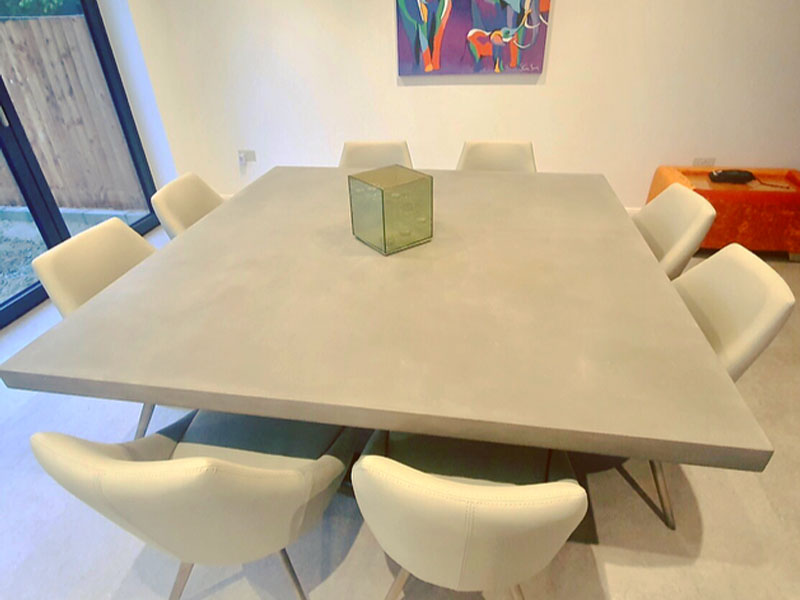
It is also the most practical format for a shared feast. Platters can run down the centre, guests have clear personal space and the table looks considered when styled with candles, foliage or a simple centrepiece. A long rectangular polished concrete table has particular presence here: its clean planes anchor a large room without feeling ornate.
The trade-off is intimacy. At very long lengths, conversation can split into smaller groups. That may be exactly right for lively dinner parties, but a round format creates a different atmosphere.
Round tables for easy conversation
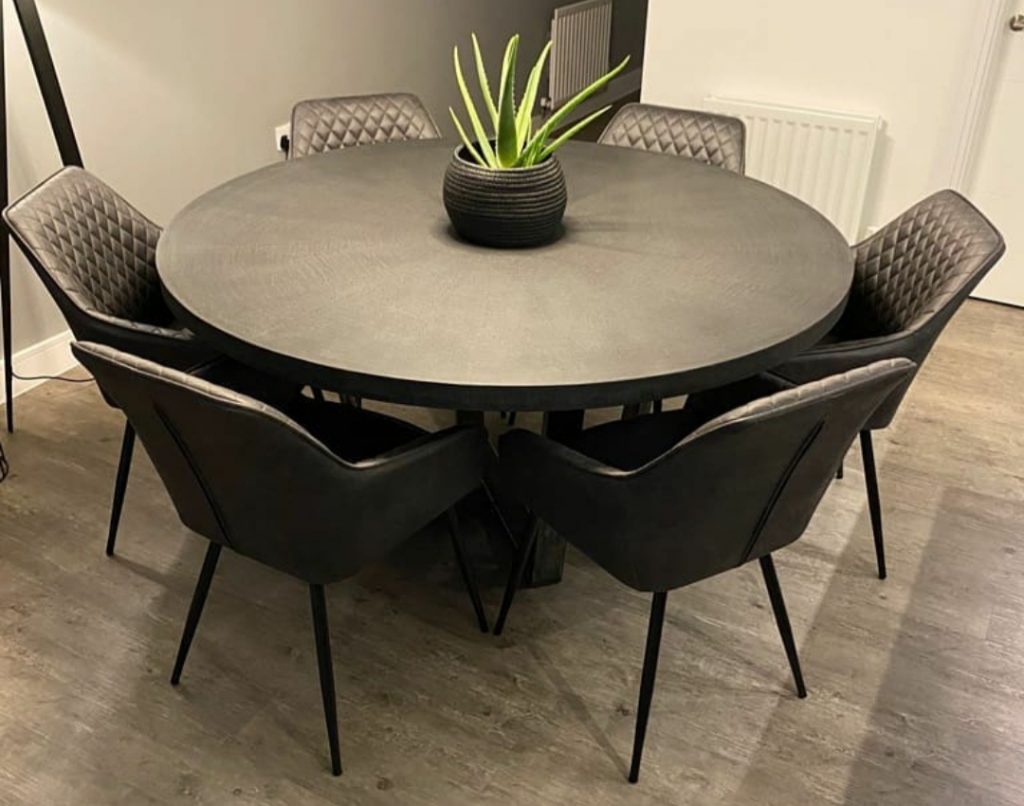
Round dining tables encourage everyone to face one another. They are excellent for sociable suppers, square rooms and spaces where there is no obvious “head” of the table. With no corners to navigate, they can also make circulation easier in compact areas.
A round table works particularly well for four to six diners. Once you move beyond that, its diameter grows quickly and reaching shared dishes becomes less convenient. In a large room, a generous round table can be a striking sculptural choice, but it needs enough surrounding space to breathe.
Oval and soft-edged designs for flexible rooms
An oval or racetrack-shaped table offers the sociability of a round form with much of the seating capacity of a rectangle. Its softened ends are useful where people need to pass behind chairs, and the silhouette can take the edge off a kitchen with strong linear cabinetry and hard architectural finishes.
This is a good option for families who want a substantial table but do not want the room to feel overly formal. It depends on the base design, though. Make sure the legs or pedestal leave comfortable knee room around the curved ends.
Material should work as hard as your guests do
Entertaining is demanding on furniture. Hot serving dishes, dropped cutlery, sauce spills, children’s craft projects and late-night drinks all test the surface. A beautiful table that makes you anxious every time someone sets down a glass is not the right table for a lived-in home.
Solid timber brings warmth and develops a patina, but it can need regular care and may mark or move slightly with changes in humidity. Veneers can offer a refined look at a lower weight and price point, although they are less forgiving of deep damage. Glass keeps a room visually light but shows fingerprints quickly and can feel less relaxed for large, informal gatherings.
Polished concrete offers a compelling balance for design-led households. Its weight, tactile finish and natural variation give it a distinctive urban character, while a properly sealed surface is designed for everyday use and is stain resistant. Each hand-finished top carries subtle movement in tone and texture, so the table feels made rather than mass produced.
Concrete is not trying to imitate marble, timber or stone. It has its own material honesty: cool, substantial and quietly expressive. For homes with oak cabinetry, black-framed doors, plaster walls or natural stone floors, it can provide contrast without competing for attention.
That said, concrete is a considered investment and a substantial piece of furniture. Delivery access, floor level and the route into the room should be discussed early. A specialist maker can plan this properly, rather than leaving a beautiful table stranded at the front door.
Look beneath the tabletop
For entertaining, the base is as important as the top. Four legs near the corners are familiar and stable, but can limit where guests sit. This matters most when you would like to add an extra person at short notice.
A central pedestal or carefully positioned twin base often gives more freedom for chairs and legs. It can make a large table feel lighter too, particularly if the base is set back from the ends. The best choice comes down to the chair style, table length and whether you prefer a crisp industrial profile or a warmer, more sculptural look.
Think about proportions rather than choosing the base in isolation. A thick, substantial top may suit bold steel legs or a solid pedestal. A slimmer top can carry a more refined frame. The result should feel calm and balanced from every angle, including the view from the kitchen island or sitting area.
Make the table fit the whole room, not just the floorplan
A table can meet the measurements on paper and still feel wrong if its finish jars with the room. Consider what is already doing visual work: a statement island, patterned floor, feature lighting, exposed brick or large garden doors. Your dining table should give the scheme a centre of gravity.
For a quiet, gallery-like interior, a pale grey or warm off-white concrete finish can sit beautifully with limewash walls and light oak. Deeper charcoal tones bring drama to bright extensions and work well with black metal details. Neutral does not have to mean flat. The character lies in the hand-finished surface, the edge profile and the proportion of the form.
Chairs deserve equal attention. Upholstered dining chairs soften concrete’s architectural feel and make lingering over coffee more appealing. Timber chairs create warmth, while leather and metal can lean into a more industrial look. Before committing, check seat height against the final tabletop height and allow enough width for each chair to slide in without touching its neighbour.
Why made-to-measure often wins for entertaining
Standard table sizes work well when your room and guest list happen to fit them. Bespoke design becomes valuable when they do not. Perhaps the room needs a 245cm table rather than 240cm or 260cm. Perhaps a narrow dining area needs softened corners, or an existing banquette requires a precise depth. Those details determine whether a table feels intentionally designed for the home.
A made-to-measure table also lets you choose the finish, colour, edge and leg style as one composition. Rather than compromising between a size you need and a look you love, you can resolve both. Daniel Polished Concrete offers standard six, eight and 10-seater formats for straightforward projects, alongside bespoke builds for spaces that call for something more individual.
The most successful entertaining table is not necessarily the largest or the most elaborate. It is the one that welcomes people in, gives them room to settle and becomes more familiar with every gathering. Choose a form and finish you will enjoy on an ordinary Tuesday, then let it rise to the occasion when the house is full.