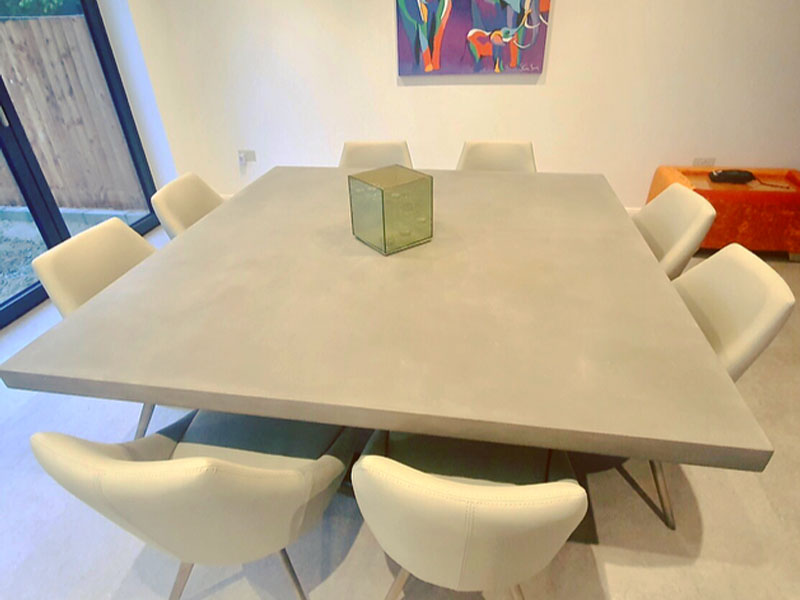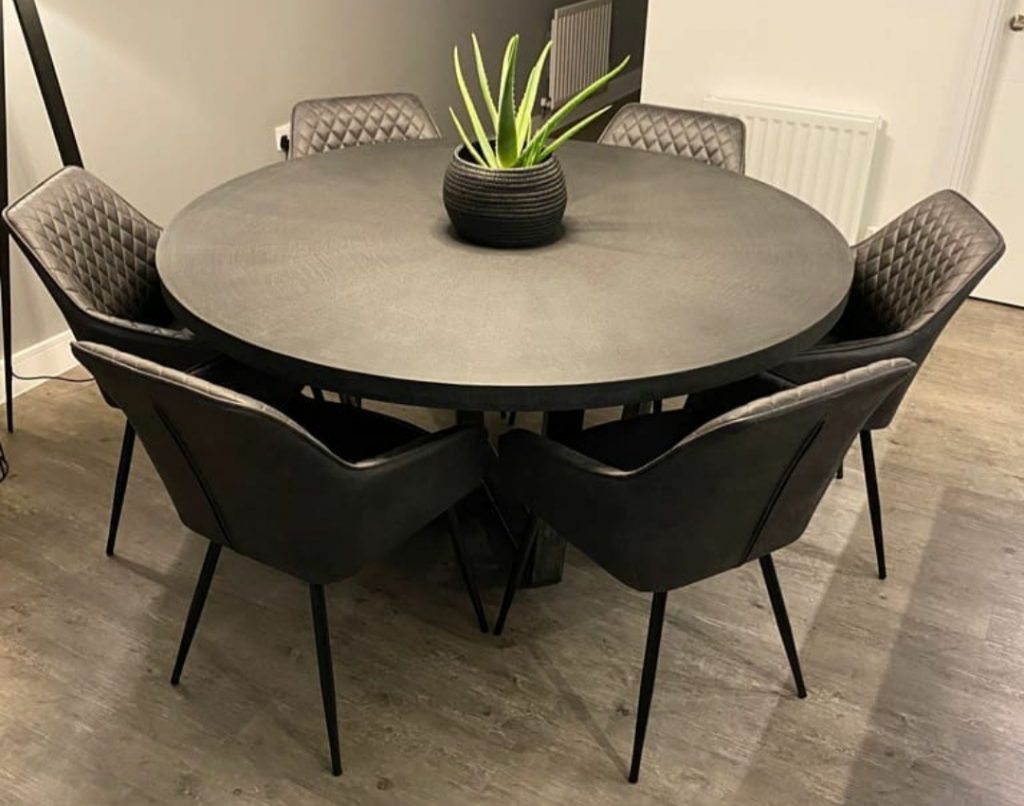

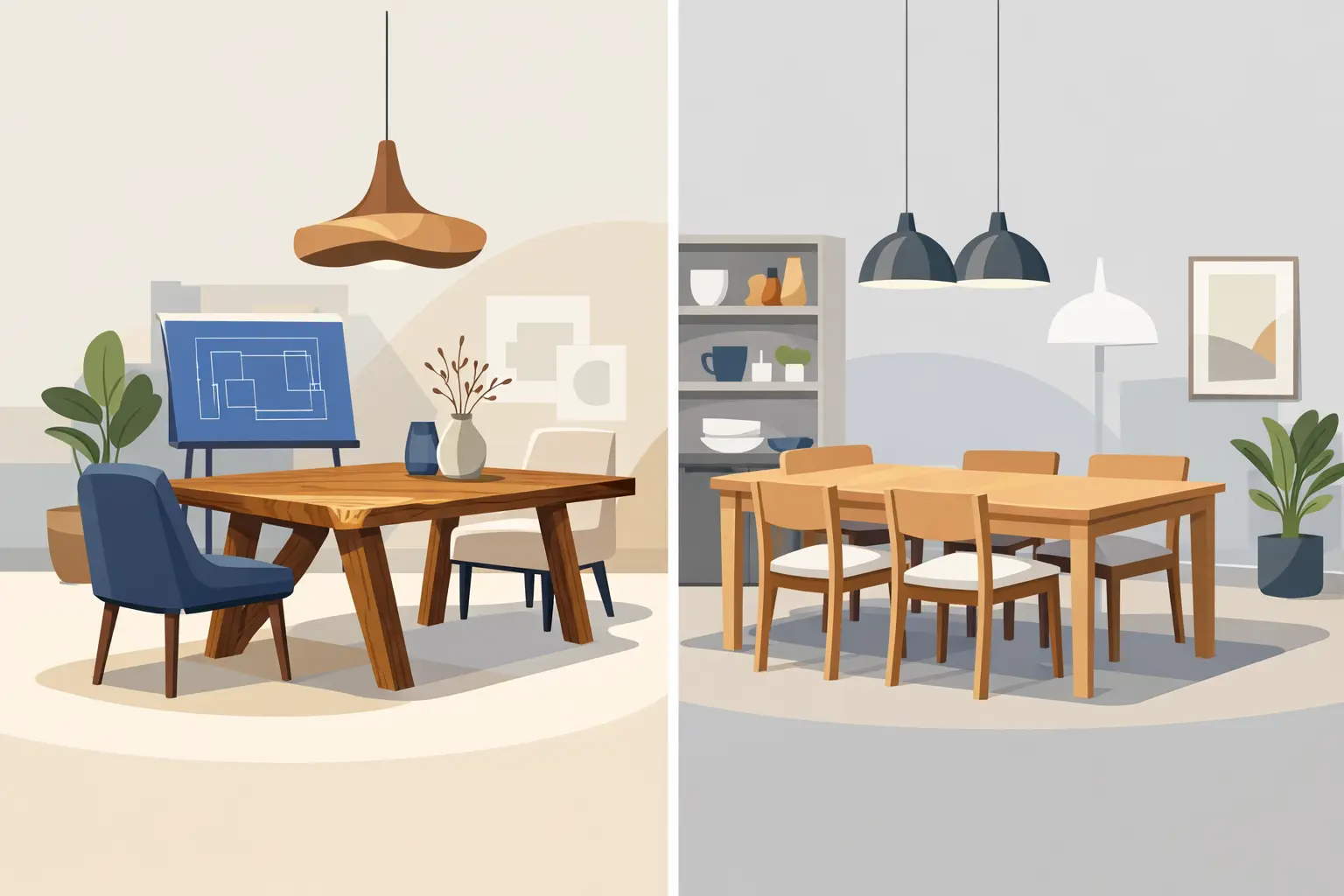
A dining table can look perfectly proportioned in a showroom, then feel oddly small once it is surrounded by chairs, pendant lights and the daily movement of family life. That is the real question behind a bespoke dining table vs off the shelf purchase: not simply which looks better, but which will genuinely belong in your room for years to come.
For a renovated kitchen, an open-plan extension or a forever home, the table is often the anchor of the whole scheme. It needs to seat people comfortably, work with the architecture and withstand the less glamorous reality of weekday meals, homework, celebrations and guests. A polished concrete table can do all of that, but the route you choose – a standard configuration or a made-to-measure commission – changes the result.
Bespoke Dining Table vs Off the Shelf: The Real Difference
An off-the-shelf dining table is designed to suit a broad range of homes. It comes in a fixed selection of lengths, widths, finishes and base styles, usually with a shorter lead time and a clearer starting price. That can be exactly right when your room suits a standard size and you want a considered decision without a long design process.
A bespoke table begins with your space instead. Its dimensions, shape, concrete colour, surface finish and leg design are chosen around the way you live. It is not about adding options for their own sake. It is about resolving the details that make a dining area feel calm and intentional: the clearance around each chair, the relationship with a kitchen island, or the exact length needed for ten people without overwhelming the room.
With polished concrete in particular, proportion matters. The material has a confident, architectural presence. A table that is too narrow can lose its usefulness, while one that is too deep or too long can dominate circulation through an open-plan room. Bespoke work gives you the freedom to strike that balance rather than compromise around a standard catalogue measurement.
Start With the Room, Not the Table
The most common mistake is measuring the space where the tabletop will sit and stopping there. A dining table needs room to be used. Chairs must pull out, people need to pass behind them and doors, drawers and kitchen units still need to function.
As a practical guide, allow roughly 90 cm from the edge of the table to a wall or obstruction where possible. In a busy family kitchen, more breathing room is often worthwhile. You should also consider the footprint of the chairs you actually want, particularly if they have arms or a generous curved back.
This is where bespoke becomes valuable. Perhaps your extension has an impressive run of glazing but a pinch point near a pantry door. A 2.4 m table may be ideal in length, yet a slightly slimmer width could make the room work far better. Or perhaps a rounded end will soften the route from the kitchen into the dining area without reducing the number of guests you can seat.
A rectangular table remains the most efficient choice for larger gatherings, especially for eight, ten or twelve settings. However, softer corners, a racetrack shape or a fully round table can create a more social feel where space allows. These are not minor decorative choices. They affect how the room flows and how people gather around it.
When an Off-the-Shelf Table Is the Better Choice
Off the shelf does not have to mean ordinary. A well-designed standard table offers the same material quality and visual impact as a more individual commission when the dimensions already fit your brief.
For many homes, a standard six, eight or ten-seater configuration is a smart route. It makes the decision simpler, helps keep costs more efficient and can reduce the time between choosing your table and enjoying it at home. If you have measured carefully and a standard size gives everyone enough elbow room, there is little benefit in forcing customisation.
A Classic Collection piece can be particularly appealing if you are furnishing a new dining room quickly, replacing an existing table with a similar footprint, or working to a clear budget. You still receive the depth, subtle tonal variation and hand-finished character that make polished concrete such a striking material. The important difference is that the design decisions have already been thoughtfully resolved.
There is also reassurance in choosing a proven format. Standardised proportions have been refined to work well with everyday seating, and they make it easier to plan a room before the table arrives. For a straightforward space, that certainty is often more useful than unlimited choice.
What Bespoke Gives You That Standard Sizes Cannot
A bespoke dining table earns its place when the room, household or design ambition asks for something more specific. That may mean creating a generous table for a growing family, matching an unusual floor plan, or selecting a finish that ties together stone, timber, metal and cabinetry elsewhere in the room.
The most obvious advantage is size. A made-to-measure table can be built to the precise length and width your layout requires, rather than asking you to choose the nearest available option. Those extra 10 or 20 cm can make the difference between comfortably seating ten adults and squeezing them in.
Shape is equally important. In a long, narrow room, softened corners can make moving around the table easier. In a square kitchen-diner, a round or oval design may encourage better conversation and reduce visual bulk. A bespoke base can also be planned around dining chairs, ensuring that legs sit where people do not need to sit.
Then there is the finish. Polished concrete is not a printed surface repeated from one table to the next. It is hand-finished, with natural movement and character that give every piece its own identity. Choosing the concrete tone and leg style allows the table to sit confidently within an urban, industrial scheme or bring a cooler contemporary edge to warmer timber-led interiors.
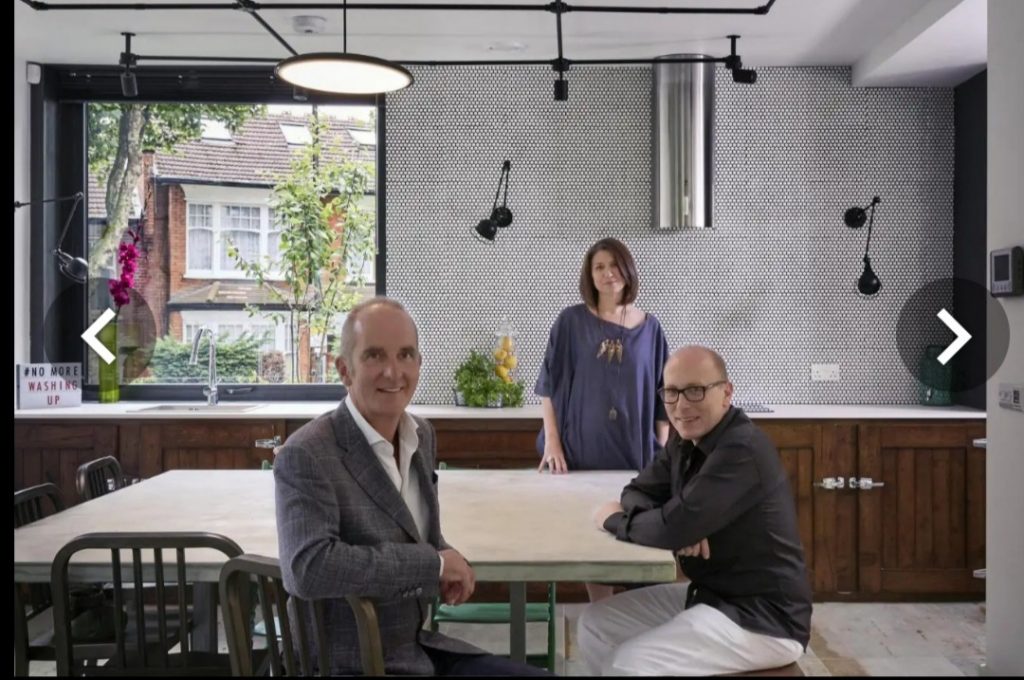
At Daniel Polished Concrete, this process is consultation-led because the detail is what transforms a good idea into a table that feels made for its setting. Photographs and floor plans are useful, but so is a conversation about how many people sit down on an ordinary Tuesday, how often you host, and whether the table needs to accommodate a large Christmas gathering.
Cost, Lead Time and Long-Term Value
The price difference between bespoke and off-the-shelf furniture is real. A standard table is generally more price-efficient because its design, dimensions and production process are already established. Bespoke work involves more planning, more individual decisions and a build tailored to one brief.
It is worth looking beyond the initial figure, though. Dining tables tend to be long-term purchases, especially in homes where the kitchen-diner is the centre of daily life. A table that fits beautifully, seats the right number of people and remains relevant after a renovation is often better value than a less expensive piece that is soon outgrown or replaced.
Lead time deserves the same honesty. A collection table may suit a project with a firm completion date or a household eager to get settled. A bespoke commission requires time for design, making, finishing and careful delivery planning. If your interior is still evolving, that additional time can be a benefit rather than a drawback, giving you space to make choices you will not regret.
Everyday Practicality Matters as Much as Style
Concrete has an undeniably sculptural quality, but a dining table must also be lived with. A properly finished polished concrete surface is hard-wearing and designed for regular use. Its tactile feel, understated sheen and substantial presence make it a centrepiece without making it precious.
As with any premium surface, sensible care helps preserve its finish. Wipe spills promptly, use mats for very hot dishes and avoid harsh abrasive cleaners. The aim is not to create a table you are afraid to use. It is to let it gather the gentle signs of a well-loved home while maintaining the quality of the hand-finished surface.
Weight is another practical consideration. Concrete furniture is substantial, which contributes to its reassuring stability and permanence. It also means access should be considered early. Stairways, door widths, parking and the route into the room all matter, particularly in period properties or upper-floor flats. A specialist maker can advise on delivery and installation before the build is underway, rather than leaving a difficult surprise for moving day.
How to Make the Right Choice
Choose off the shelf when your room works with a standard size, your timeline is tight and you prefer a highly considered design with fewer decisions. It is an excellent choice when a strong, enduring table is the priority and the format already answers your practical needs.
Choose bespoke when the dimensions are unusual, the room has architectural constraints, or you want the table to respond precisely to your interior. It is also the stronger option when seating capacity is non-negotiable, such as a family that regularly needs eight, ten or more places without sacrificing comfort.
Before committing to either route, mark the proposed tabletop size on the floor with masking tape. Place chairs around it, open nearby cupboards and walk the route through the room. This simple exercise reveals more than a product photograph ever can. The right table should not merely fill the available space; it should make the whole room easier and more enjoyable to live in.