

A table can look perfect in a showroom and feel completely wrong once it lands in your dining space. Too small, and it looks lost. Too large, and every chair movement becomes a shuffle sideways. If you are asking what table size fits my room, the answer starts with more than the tabletop itself – it starts with how you actually live around it.
In most homes, the dining table is doing several jobs at once. It hosts weekday dinners, long Sunday lunches, homework, laptop hours, birthday candles and the occasional glass of red that should have stayed further from the edge. That is why getting the size right matters. A well-proportioned table does not just fit the room. It gives the room its rhythm.
What table size fits my room? Start with clearance
The most common mistake is measuring the available floor area and choosing the largest table that technically squeezes in. On paper, that can seem sensible. In real life, you also need room to pull chairs out, move around seated guests and keep the space feeling calm rather than cramped.
As a rule, allow at least 90cm between the edge of the table and the wall or any other fixed furniture. That is the practical minimum in many dining rooms. If the space is a main walkway, or part of an open-plan kitchen where people pass behind chairs regularly, 100 to 120cm is far more comfortable.
This is where bespoke sizing becomes especially useful. A difference of even 10 or 15cm in length or width can transform how a room functions. In a renovated kitchen-diner, that small adjustment might be the difference between a generous entertaining space and one that constantly feels tight around the edges.
Measure the room the right way
Start by measuring the usable area, not just the room from wall to wall. Radiators, sideboards, kitchen islands, door swings and bifold thresholds all affect what will work.
Mark the table footprint on the floor with masking tape or newspaper. Then pull a chair back as if someone were sitting down. Walk around it. Open nearby doors. Stand at the hob or island if the dining area is part of a larger family room. This simple exercise tells you far more than dimensions on a screen ever will.
If you are furnishing an open-plan room, think in zones rather than boundaries. A dining table should feel anchored within its own area, with enough breathing space to read as a deliberate centre piece rather than an oversized object drifting between kitchen and lounge.
Standard dining table sizes and what they mean in practice
There is no single perfect size because shape, leg placement and seating style all change the result. Still, there are some reliable starting points.
A 4 seater dining table is often around 120 to 140cm long and 75 to 90cm wide. This works well in smaller dining rooms or compact kitchen extensions where daily family use matters more than entertaining larger groups.
A 6 seater table is typically around 160 to 180cm long. This is often the sweet spot for many homes because it feels generous without dominating the room. It suits growing families and gives enough surface area for placemats, serving dishes and a bit of elbow room.
An 8 seater table usually starts around 200cm and can extend to 240cm depending on the design. In open-plan spaces, this size has real presence. It starts to become architectural rather than merely functional.
A 10 seater table often sits around 260 to 300cm long. At this scale, proportion becomes critical. The room needs enough volume around the table for it to feel intentional and balanced, especially if you want the piece to act as a strong visual focal point.
Width matters too. Around 90 to 100cm is comfortable for everyday dining. Wider tables can look striking and feel luxurious, but if you go too wide, conversation across the table becomes less natural and serving dishes are harder to reach.
Shape changes everything
When homeowners ask what table size fits my room, they are often really asking which shape will make the room work best.
Rectangular tables are the natural choice for longer rooms and open-plan layouts. They make strong use of length and suit larger seating counts beautifully. A polished concrete rectangular table also has a confident, architectural quality that works particularly well in modern interiors.
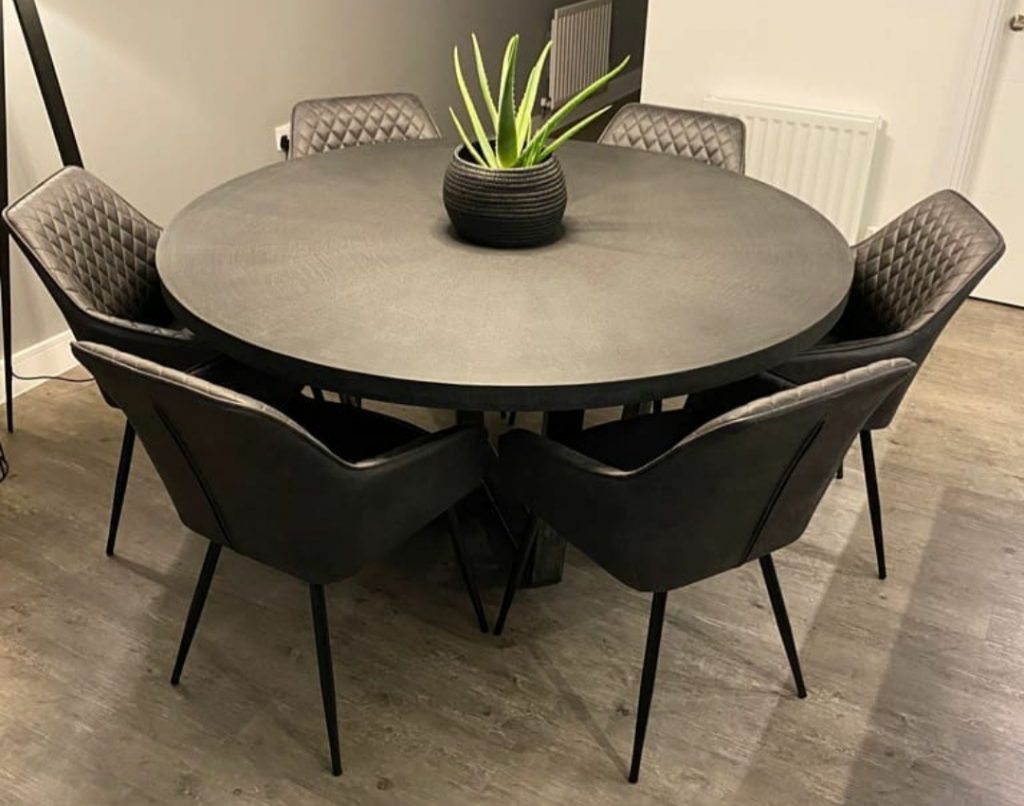
Round tables are excellent for softer circulation and more intimate dining. They remove hard corners and can work brilliantly in square rooms. The trade-off is that once you move beyond a certain diameter, they need a surprising amount of floor space.
Oval tables offer some of the benefits of both. They soften the overall look while still handling longer guest lists well. If you want a large table without the visual severity of a strict rectangle, an oval can be a very elegant solution.
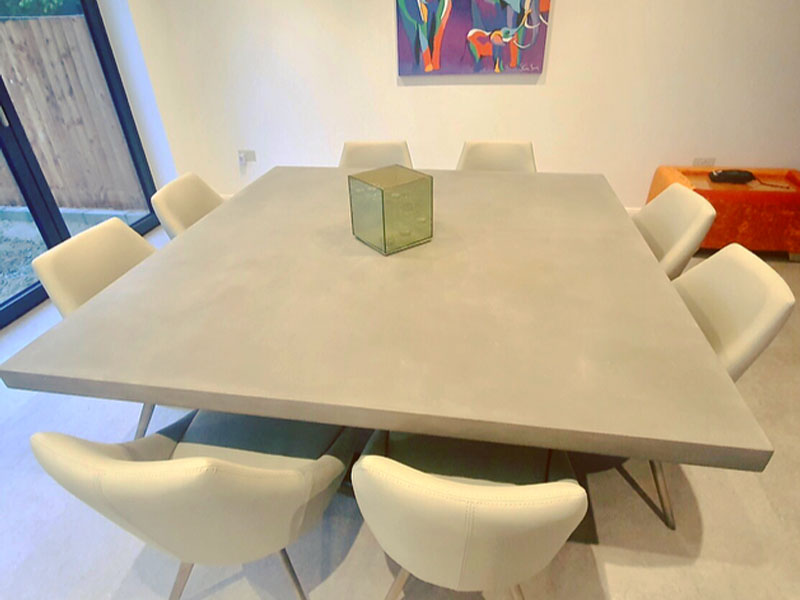
Square tables can look impressive in the right setting, but they need room. They are best in genuinely square rooms or generous open spaces where symmetry is part of the design.
Think about chairs before you commit
It is easy to focus on the tabletop and forget the reality of seating. Chair width, armrests and leg positions all influence how many people a table can comfortably accommodate.
For most dining setups, allow around 60cm per person along the length of the table. If your chairs are broad, upholstered or have arms, you may want closer to 65 or 70cm. End seats also need proper knee room, especially where pedestal or sculptural leg designs are involved.
This is one reason a made-to-measure table can outperform an off-the-shelf option. You are not forced into generic dimensions that almost work. You can size the piece around your preferred chairs, your entertaining habits and the exact proportions of the room.
Material and visual weight matter as much as dimensions
A table does not only occupy physical space. It occupies visual space too.
Polished concrete has presence. That is part of its appeal. It brings texture, depth and a sculptural quality that can make a dining area feel resolved and high-end. In a well-proportioned room, that sense of weight is stunning. In a room where the table is too bulky for the footprint, it can feel heavy.
That does not mean concrete only suits large spaces. It means proportion and detailing matter. The right thickness, edge profile, base style and finish can keep the piece elegant rather than overpowering. In many homes, a bespoke concrete table works precisely because it can be tuned to the room instead of forcing the room to adapt to it.
Room-by-room guidance
In a compact dining room, prioritise circulation and softness. A round or narrower rectangular table may serve you better than chasing maximum seat count. If you only host larger groups a few times a year, it may be smarter to size for everyday comfort.
In an open-plan kitchen-diner, larger rectangular tables often come into their own. They help define the dining zone and stand up visually against substantial cabinetry, islands and glazed doors. Here, an 8 or 10 seater can feel exactly right, provided the clearance around it is generous.
In a forever home where entertaining is central, think long-term. Children grow, families gather and habits change. Going slightly larger can make sense if the room supports it. The key is choosing a size that still feels comfortable on an ordinary Tuesday, not just at Christmas.
When bespoke is the better answer
Standard sizes are useful, but real homes are rarely standard. Period alcoves, extensions with unusual proportions, feature lighting positions and mixed-use family spaces all create awkward decisions if you are limited to fixed dimensions.
That is often where a consultation-led approach makes the difference. A table can be made a little shorter to preserve a walkway, a little narrower to improve flow to the garden doors, or shaped to soften a tight corner. Those small decisions create a piece that feels as though it belongs to the architecture of the room.
For homeowners investing in a statement dining table, that is usually the point. You are not simply filling a gap. You are commissioning something that should look exceptional, work hard and still feel right years from now.
If you are unsure, start with the room, not the table. Measure the clearances honestly, think about how many people sit there most often, and consider the shape and visual weight that suit your home. A beautiful table should command attention, but it should never get in your way. If the proportions are right, the whole room settles around it – and that is when a dining table becomes more than furniture.