
A dining table is often the first thing people notice in an open-plan kitchen, yet it is also where real life happens: weekday suppers, homework, celebrations and long conversations that run past midnight. Luxury concrete furniture is made for precisely that balance. It brings the quiet confidence of an architectural material into the home, while offering the strength, individuality and everyday practicality a serious dining space demands.
Polished concrete has moved well beyond its industrial associations. Hand-finished properly, it can feel refined, warm and remarkably tactile. Its natural movement, subtle tonal variation and softly polished surface make every piece distinctive, whether it sits beneath pendant lighting in a newly extended kitchen or anchors a more characterful period home.
Why luxury concrete furniture feels different
The appeal is not simply that concrete looks striking. It is that it has presence. A well-proportioned concrete dining table has a visual weight that allows it to hold its own in a large room without relying on ornate detailing or unnecessary decoration. It becomes a stunning centrepiece through material, scale and craftsmanship.
Unlike mass-produced furniture, polished concrete carries the hand of its maker. Fine variations in colour, tiny pinholes and gentle clouding are not defects to be erased. They are part of the material’s character, much like the grain in timber or veining in stone. The result is a table with depth rather than a perfectly uniform surface that could belong anywhere.
That individuality makes concrete especially compelling for homeowners who have invested in a kitchen renovation or a forever home. If the cabinetry, flooring and lighting have been carefully considered, an off-the-shelf table can feel like an afterthought. A made-to-measure concrete piece gives the room a focal point designed around its actual proportions.
Luxury concrete furniture for real homes
There is a common assumption that concrete furniture is cold, impractical or better suited to a gallery than a family home. The reality depends on how the piece is designed, finished and cared for. A polished concrete dining table is not a paving slab on legs. It is a carefully engineered furniture surface, hand-finished and sealed to support daily use.
A quality sealer helps protect the table from the marks and spills of family life, while the polished finish makes the surface comfortable to live with. As with timber, marble or any premium natural material, sensible care matters. Wipe spills promptly, use placemats for very hot dishes and avoid harsh cleaning products. These small habits preserve the finish and allow the table to develop beautifully over time.
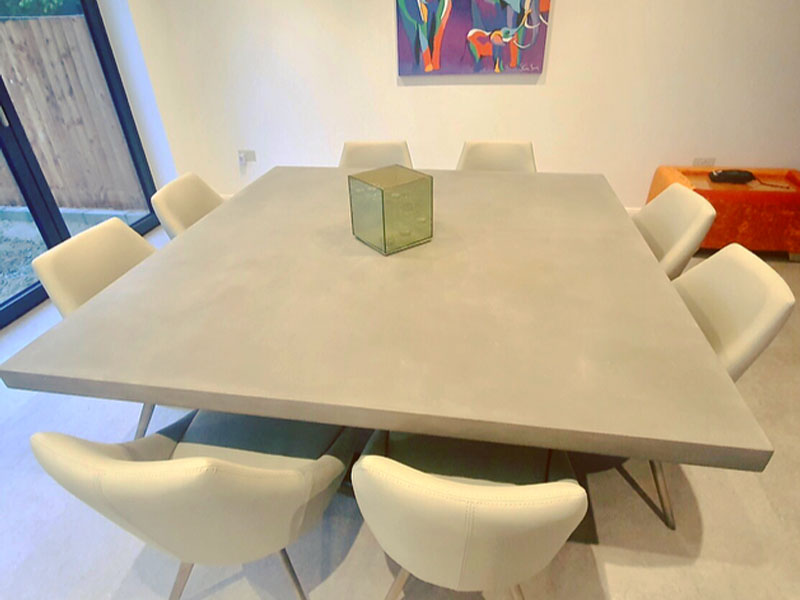
Concrete also offers a practical advantage in rooms that work hard. It is substantial, stable and well suited to generous dining formats. For a busy household that needs eight, ten or even twelve seats, the table can feel grounded rather than visually flimsy. That said, its weight needs to be considered from the beginning. Access, staircases, flooring and installation should all form part of the conversation before a design is finalised.
The importance of proportion
The most successful table is rarely chosen by seat count alone. A six-seater can feel generous or cramped depending on chair width, leg placement and the room around it. Equally, a ten-seater should not dominate the circulation space simply because there is technically room for it.
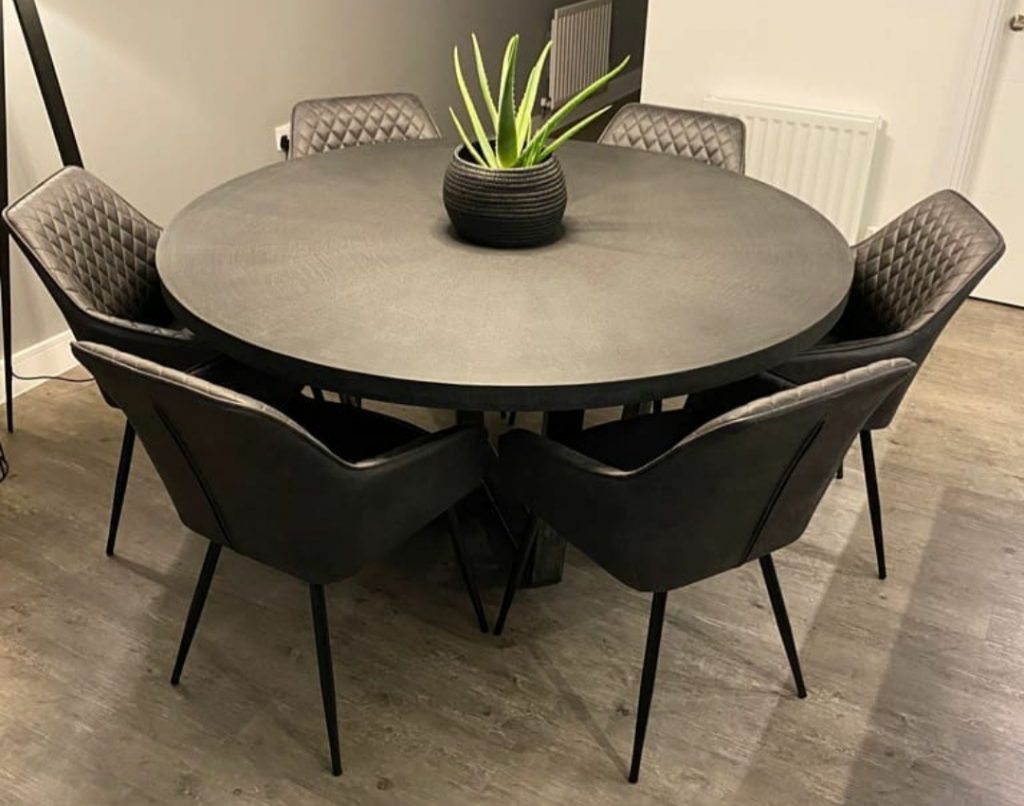
Start with how the room is used. Allow enough space to pull out chairs comfortably, walk behind seated guests and move between the kitchen and dining area without squeezing past corners. The shape matters too. A long rectangular table suits many kitchen-diners, while a softer oval can improve flow in a narrower space and make conversation easier. Round forms work beautifully where a more social, sculptural arrangement is wanted.
This is where bespoke furniture earns its value. Rather than adapting your home to a standard size, the table can be made around the way you live in it.
Choosing the right finish, colour and base
Concrete is not limited to one shade of grey. Its colour can be tuned from pale, almost chalky tones through warm greys to deeper charcoal finishes, with each mix responding differently to light. A lighter table can lift a darker kitchen and sit elegantly with natural oak, linen and brushed metal. A deeper surface has more drama, particularly alongside pale cabinetry, plaster walls or expansive glazing.
The finish should work with the wider interior rather than compete with it. A calm, softly polished concrete top can bring balance to strongly veined stone worktops or colourful joinery. In a more minimal scheme, it can become the feature itself. Samples are valuable at this stage because concrete changes throughout the day. The colour you see in a workshop or on a screen is not necessarily the colour you will experience beside your own windows, flooring and lights.
Leg design has an equally strong influence on the final character. Slim metal legs can give a table a lighter urban design feel, while a more substantial base creates a monolithic, architectural statement. The practical question is just as important as the visual one: a base must leave enough room for chairs, knees and place settings. A beautiful table that makes guests awkwardly straddle a leg is not a successful dining table.
Bespoke or a Classic Collection?
There are two sensible routes, and neither is automatically better. A Classic Collection table in established six, eight or ten-seater proportions is often the right choice when the room suits a proven size and the priority is a clearer specification with stronger price efficiency. It offers the confidence of a refined design without starting from a blank page.
A bespoke commission is the better fit when the room presents a particular challenge or the table needs to answer a very personal brief. Perhaps a large extension needs an extra-long table with a slim profile, an awkward bay calls for an oval, or the surface needs to complement a carefully chosen kitchen palette. Dimensions, shape, colour, finish and leg style can then be considered as one complete piece rather than a series of compromises.
For many clients, the decision comes down to confidence. If you know exactly what you need, a classic configuration is refreshingly straightforward. If you can picture the room but cannot find the right table for it, bespoke design provides the freedom to get the details right.
What hand-finished craftsmanship changes
Concrete furniture should never feel anonymous. Every stage affects the final result: casting, curing, refining the surface, polishing, sealing and fitting the base. Those processes require judgement, not just machinery. The maker has to understand how the material will behave and how a slight tonal shift or edge detail will read in the finished piece.
That level of attention is particularly important at larger scales. A long dining table needs to look composed from every angle, with a finish that feels consistent while still retaining the natural life of concrete. It also needs to be designed for transport and careful installation, because a statement piece deserves more consideration than a flat-pack delivery left at the kerb.
Daniel Polished Concrete has delivered more than 2,500 bespoke projects across the UK and Europe, bringing that experience to the technical as well as aesthetic side of each commission. A direct conversation before production can resolve questions about access, dimensions, chair layouts and finish choices early, when changes are easiest to make.
A table that improves the room, not just fills it
Luxury furniture should not ask a household to preserve it like a museum piece. It should make daily rituals feel better: breakfast in the morning light, a crowded Sunday lunch, drinks with friends after the children are asleep. Concrete has the composure to look exceptional on those occasions, and the substance to remain reassuringly useful between them.
The best starting point is to measure the space honestly, think about the people who will gather around it and choose a design with enough character to reward a second look. When a table is made for its setting, it does more than furnish a room. It gives the room a reason to gather.