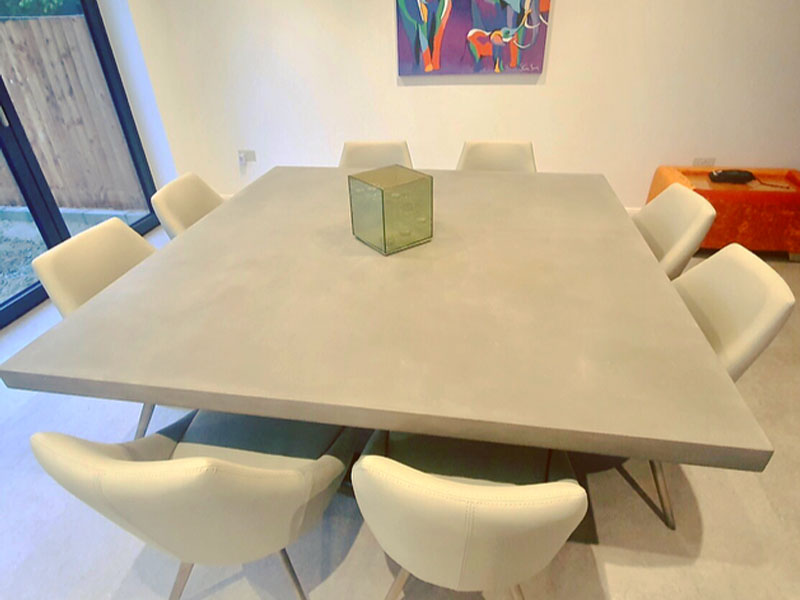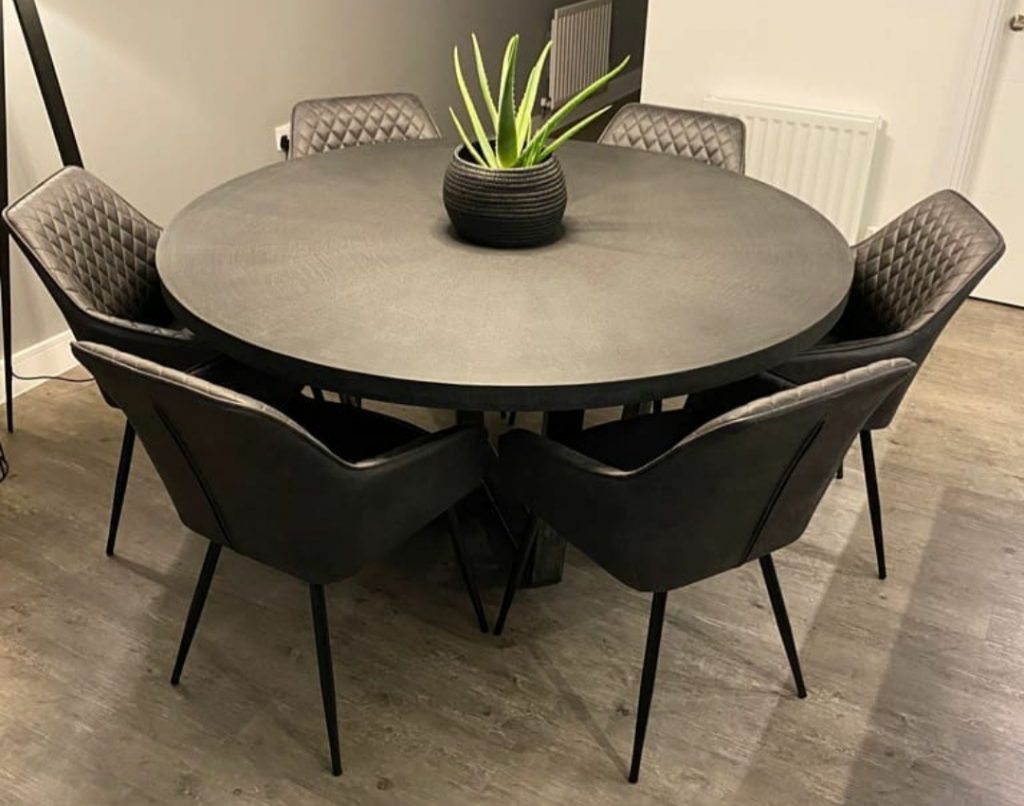


A polished concrete dining table should feel substantial. That grounded, architectural presence is part of its appeal. But are concrete tables too heavy for a real family home, a kitchen extension or an upstairs dining room? The honest answer is that they can be heavy, but weight is something to design around, not a reason to rule out the material.
A well-made concrete table is not simply a thick slab placed on legs. Its construction, dimensions, base design and route into the property all matter. When those details are considered at the beginning, a concrete table can be a practical, long-lasting centre piece as well as a striking one.
Why concrete tables feel heavier than other dining tables
Concrete is naturally denser than timber, laminate and most engineered dining-table materials. A solid oak table may take two people to manoeuvre, while a comparable concrete top may require a carefully planned delivery team and more hands on the day. That difference is real.
Yet the visual weight of a table and its actual weight are not the same thing. Polished concrete has a calm, monolithic look that suits open-plan kitchens and modern interiors, but a bespoke piece can be engineered with slim proportions, a refined edge profile and a base that gives the top a lighter, floating appearance.
The question is less about whether concrete is heavy and more about whether the table has been made appropriately for its intended setting. A large ten-seater dining table needs a different approach from a compact round table for a townhouse kitchen. The right build begins with the room, the people using it and the access to the space.
How much does a concrete dining table weigh?
There is no useful single figure because every table is different. A smaller concrete dining table may be manageable with a professional two-person team, while a substantial eight, ten or twelve-seater statement piece can weigh considerably more. Surface area, thickness, shape, reinforcement and the type of legs or plinth all contribute.
As a rough principle, a longer and wider top carries more material, and therefore more weight. A 3-metre dining table designed for generous entertaining will understandably require more planning than a six-seater table. Round and oval tables can also vary significantly depending on their diameter and the chosen base.
This is why a made-to-measure approach is valuable. Rather than selecting a table from a generic specification and hoping it works, the weight can be considered alongside the dimensions, finish and support structure. At Daniel Polished Concrete, each commission is approached as a piece of furniture for a particular home, not just a surface to be manufactured.
Thickness is only one part of the story
It is tempting to assume a thinner-looking top must be light. In practice, a slim profile still needs the correct reinforcement and support to remain stable over years of daily use. Equally, a thicker edge can sometimes be created as a visual detail without making the entire top unnecessarily bulky.
The construction beneath the finished surface matters just as much as what the eye sees. A specialist maker can balance strength, appearance and practical handling, ensuring the table has the satisfying solidity people expect from concrete without adding material where it does not serve a purpose.
The base changes both the look and the load
A concrete top needs a base designed to support it properly. Steel legs, timber structures, sculptural plinths and bespoke metal frameworks each create a different character, from industrial urban design to softer contemporary warmth.
They also affect how the load is carried. A well-positioned base supports the top evenly and keeps the table stable when guests lean in, children climb around it or a large serving platter lands in the middle. The feet of the base should be considered too, particularly on timber flooring, where appropriate protection helps prevent marking and spreads pressure sensibly.
Are concrete tables too heavy for upstairs rooms?
For most ground-floor kitchens, dining rooms and open-plan extensions, a professionally designed concrete dining table is usually straightforward to accommodate. The key consideration is often access rather than the floor itself.
Upstairs spaces deserve a more careful conversation. In a converted loft, first-floor flat or older property, the floor construction, the size of the table and its position in the room should all be assessed. A table is a static item, but it should never be treated casually where there are questions about structural capacity. If there is any doubt, particularly in a period home or a major renovation, ask your builder or structural engineer for advice before confirming the design.
It is also worth thinking about the complete arrangement. A dining table does not sit alone: chairs, sideboards, people and the occasional lively gathering all add load to one area. This does not mean concrete is unsuitable upstairs. It means a bespoke table should be planned with the same care as the kitchen island, flooring and lighting around it.
Delivery matters as much as the table itself
The delivery route is one of the first practical details to establish. Measure doorways, hallways, turns on staircases, gate openings and any lift dimensions. Do not forget pendant lights, radiators, narrow landings or a low ceiling at the top of the stairs. These details can decide whether a table can be carried in one piece or whether the design needs adapting.
For a ground-floor extension with wide bifold doors, access may be wonderfully simple. A Victorian terrace with a narrow hallway requires more forethought. Neither is a problem when it is discussed early, but it is frustrating when left until delivery week.
A professional installation team will plan the handling method, protect the route where needed and position the table correctly. Once installed, concrete furniture is not designed to be repeatedly shuffled across a room. That is part of the trade-off for its permanence and presence. If you are someone who rearranges furniture every season, a lighter dining table may suit your lifestyle better.
Choose a table that suits the life you lead
A concrete table is ideal for households that want one defining piece of furniture to live with for many years. It suits busy family meals, long Sunday lunches, homework, celebrations and the everyday clutter of a well-used kitchen. Its sealed polished surface is designed for practical use, while its natural tonal variation means it remains visually interesting rather than looking mass-produced.
However, it may not be the best choice for a temporary rental, a home where furniture must be moved frequently, or a room with very restricted access. There is no benefit in forcing a material into a space where it cannot be delivered or supported with confidence.
For a forever home, the opposite is often true. The permanence that initially raises questions becomes a virtue. A concrete dining table does not feel disposable. It anchors the room, gives an open-plan space a clear focal point and develops meaning through years of shared meals.
Practical ways to make a concrete table work beautifully
Start with the room rather than a standard measurement. Allow enough space to pull chairs back comfortably, walk around the table and open nearby cupboards or patio doors. A table can be generous without overwhelming the layout.
Next, be open about access. Photographs, measurements and a simple description of the route into the house can shape the design before production begins. If a large single-piece top is impractical, there may be options in scale, geometry or base configuration that preserve the look you want.
Finally, consider the table as part of the wider interior. A darker concrete finish can add drama against pale oak cabinetry; a lighter tone may soften black-framed glazing and polished plaster walls. The legs can bring in warmth, contrast or a fine industrial line. These choices influence how substantial the table feels in the room, regardless of its actual weight.
A concrete table asks for a little more planning than an off-the-shelf dining table, and that is precisely why it can feel so personal when it arrives. Share your room dimensions, access details and the way you want to use the space with a specialist maker early on, and the finished piece can be built to belong there from day one.